
GUSTAVO DIAZ-JEREZ
COMMISSIONED WORK
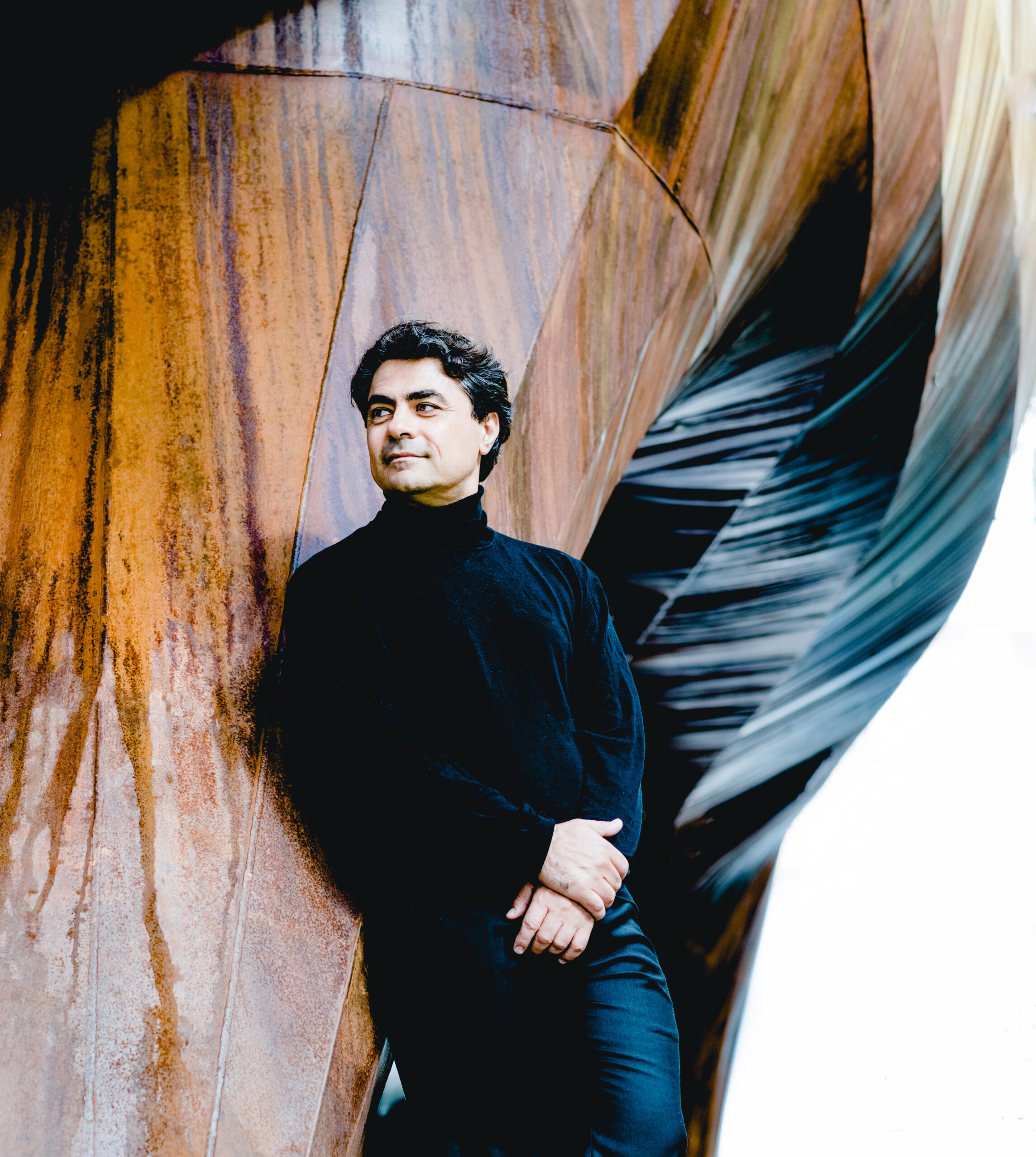
Gustavo Díaz-Jerez is one of the most distinguished Spanish pianists and composers
of his generation. He has earned international acclaim from audiences and critics
alike for his interpretations of contemporary music and the traditional repertoire.
Born in the Canary Islands, Gustavo Díaz-Jerez studied piano with J. A. Rodríguez at
the Conservatorio Superior de Santa Cruz in Tenerife, and later with Solomon
Mikowsky at the Manhattan School of Music in New York, where he also studied
composition with Giampaolo Bracali and Ludmila Ulehla. He was awarded the 2018
Martín Chirino Composition Prize.
As a composer, his works have been widely performed by soloists and ensembles
around the world. In 2011, his orchestral work Ymarxa, commissioned by the Canary
Islands Music Festival, was premiered by the Royal Philharmonic Orchestra under
Charles Dutoit. His first opera, La casa imaginaria, premiered in 2018 to great public
acclaim. In January 2024, the London Philharmonic Orchestra premiered Tajogaite,
his second piano concerto, with Díaz-Jerez as soloist. The work received its UK
premiere, again with the LPO, during the 2025-26 season at Queen Elizabeth Hall in
London. His works are published by the London-based Composer’s Edition.
His compositional language may be described as “algorithmic spectralism”,
combining elements of the spectralist movement (Grisey, Murail, Radulescu, etc.), in
which timbre plays a fundamental role. An accomplished programmer, Gustavo
Díaz-Jerez is the creator of FractMus, a Windows application that explores
algorithmic and generative composition. He has written numerous articles on the
subject, published in prestigious publications such as Electronic Musician. From
2009 to 2012, he was a researcher on the University of Málaga’s “Melomics” project,
a landmark initiative in the application of artificial intelligence to musical
composition. The project culminated in a recording of computer-generated works
featuring, among other artists, the London Symphony Orchestra.
He has performed extensively throughout Europe, Asia, South America, Australia,
the United Kingdom, and the United States, appearing in many of the world’s most
prestigious venues, including Carnegie Hall and Alice Tully Hall in New York,
London’s Royal Festival Hall, and many other renowned venues. He has appeared
as soloist with many of the world’s leading orchestras, including the London
Philharmonic Orchestra, the Budapest Festival Orchestra, the Turin Symphony, and
the Northern Sinfonia, as well as Spain’s foremost orchestras. He has collaborated
with conductors including Iván Fischer, Kristiina Poska, Cristian Mandeal, Matthias
Bamert, Günther Herbig, Adrian Leaper, and others. He has been invited to perform
at numerous international music festivals, including the Canary Islands
International Music Festival, La Roque d’Anthéron, the San Sebastián Musical
Fortnight, the Santander International Festival, and the Granada International
Festival.
His discography includes two CDs devoted to his Metaludios for piano, a CD of
chamber music, a CD of Manuel de Falla’s complete piano works, and a double CD
featuring Iberia and other works by Albéniz. In 2015, he made the world’s first highdefinition
video recording of Albéniz’s Iberia. In 2019, the Royal Scottish National
Orchestra (RSNO), conducted by Eduardo Portal, recorded a double CD comprising
a cycle of seven orchestral works inspired by the Canary Islands. In 2026, he releases
a new CD featuring new Metaludios. A passionate advocate for new technologies, he
runs Virtual Reality Piano, the first YouTube channel dedicated to the piano
repertoire in virtual reality.
About the work
Yayyan takes its title from an Arabic transliteration of the name once given to the region of Jaén. Written for the 68th Jaén International Piano Competition, the work approaches the musical memory of the area through the opening melodies of three compositions: the fifteenthcentury song Tres morillas m’enamoran, and two works by Emilio Cebrián Ruiz that have become deeply embedded in Jaén’s cultural identity, Himno a Jaén and Nuestro Padre Jesús.
These melodies do not function as conventional quotations. Instead, they become genetic material from which new musical organisms are generated. The principal transformative procedure is a process of fractalization defined by the recursive formula a(2n) = a(n); a(2n − 1) = successive pitches of the melody.
Thus, the even-numbered elements inherit the preceding sequence, while the odd-numbered positions introduce successive notes from the original melody. Tres morillas m’enamoran appears both in recognizable form and in its fractalized projection. Himno a Jaén and Nuestro Padre Jesús, by contrast, are present only through this process, applied to both their pitches and their rhythmic values. The source melodies are therefore simultaneously concealed and preserved: their identity survives, although their surface has been radically transformed.
This procedure reflects a broader aesthetic idea underlying the composition. Our perception of beauty—whether in music, the visual arts, or the natural world—may be profoundly connected to symmetry and repetition. Natural symmetry, however, is never mechanical. No two leaves on a tree are exactly alike, although each manifests a common formative principle. Yayyan follows this model of living repetition: gestures, contours, and pianistic patterns recur, but every recurrence is altered through register, transposition, articulation, resonance, density, or duration.
Many passages consequently exhibit non-statistical self-similarity. Musical shapes encountered at the smallest level reappear across broader temporal spans, not as exact copies but as transformed analogues. The same principle governs the work’s overall architecture. A ceremonial and freely declaimed opening leads to arching figurations, sharply articulated rhythmic mechanisms, and progressively more complex, multilayered textures. These energies converge at the golden section of the work’s complete duration, where the maximum dynamic and textural intensity is reached.
This climax also acts as the composition’s formal axis. From that point onwards, the music begins to unfold backwards: the preceding kinds of material return in reversed order, frequently employing retrograde transformations. The form therefore evokes the bilateral morphology of
most living organisms—two joined sides organized around a central axis. Once again, however, the symmetry is not literal. The returning passages are shortened by approximately 0.618033…, the reciprocal of the golden ratio, while also being transposed, compressed, redistributed across the keyboard, or otherwise transformed.


